The History of Rhinestone Fashion in Men's Clothing: From Stage to Street
The History of Rhinestone Fashion in Men's Clothing: From Stage to Street
Rhinestones have one of the most fascinating trajectories in fashion history. Once confined to the sequined costumes of Broadway performers and Las Vegas headliners, they have traveled a remarkable journey over the past century — passing through rock and roll rebellion, disco excess, hip-hop luxury, and athletic wear before arriving at their current position as one of the most compelling elements of contemporary men's designer fashion. Understanding that journey is understanding why a BARABAS rhinestone long sleeve shirt feels like such a powerful wardrobe choice in 2026.
The Origins: Rhinestones as Performance Wear
The story of rhinestones in fashion begins in the 18th century, when artisans in the Rhine Valley region of Europe discovered that rock crystals from the Rhine River had exceptional clarity and light-refracting properties. These crystals were cut and polished to mimic diamonds and quickly became popular among nobility and performers who wanted the appearance of gemstone luxury at a fraction of the cost.
By the 19th and early 20th centuries, rhinestones had become standard material in theatrical costuming. Ballet, opera, and early vaudeville performers relied on rhinestone embellishment to ensure their costumes captured light and attention from the back rows of the theater. The connection between rhinestones and spectacle — between embellishment and performance — was established early, and it would prove extraordinarily durable.
The Rock and Roll Era: Elvis and the Rhinestone Revolution
If any single moment established rhinestones as a serious force in men's fashion, it was the rise of rock and roll in the 1950s — and no one embodied this more completely than Elvis Presley. Elvis's rhinestone-covered jumpsuits, designed by Bill Belew and Nudie Cohn, were some of the most photographed garments in American cultural history. They communicated something entirely new: that men could wear embellishment not just in theatrical contexts but as an expression of personal power, charisma, and star quality.
This was the moment rhinestone fashion crossed from performance wear into something larger. Elvis's rhinestone suits said that a man could choose to shine — literally and figuratively — and that doing so was not feminine or theatrical but powerful and authentically masculine.
Disco and the 1970s: Rhinestones Go Mainstream
The 1970s disco movement took the rhinestone revolution and amplified it across the broader culture. The discotheque was a performance stage for everyone — and dressing for it meant embracing shimmer, sparkle, and embellishment as fundamental elements of men's nightlife fashion. Rhinestone shirts, sequined jackets, and embellished trousers were not exotic choices in the 1970s — they were the standard uniform of the dance floor.
This democratization of rhinestone fashion was culturally significant. It separated rhinestone embellishment from the exclusive world of professional performance and established it as something any man could wear as a statement of his own personality and love of life.
Hip-Hop and the 1990s-2000s: Rhinestones as Luxury Signaling
The hip-hop era recontextualized rhinestones once again — this time as a symbol of luxury, success, and status. Rhinestone and crystal embellishment on clothing, accessories, and footwear became associated with the kind of unapologetic self-expression and success narrative that defined hip-hop culture at its peak commercial moment. Men wore rhinestone pieces not to perform but to declare — to communicate their arrival at a level of success worth celebrating.
This shift was important because it permanently relocated rhinestone fashion within the discourse of luxury and masculinity. A rhinestone shirt was no longer a costume — it was a flex, a proclamation, a statement of earned confidence.
The Modern Era: Rhinestones in Designer Men's Fashion
Today, rhinestone embellishment is fully integrated into the highest levels of men's fashion. International luxury houses feature hand-placed crystal and rhinestone detailing in their most coveted pieces. Footballer tunnel fits and celebrity red carpet appearances regularly feature heavily embellished shirts and jackets. The rhinestone shirt has become one of the signature pieces of the modern man who takes his wardrobe seriously.
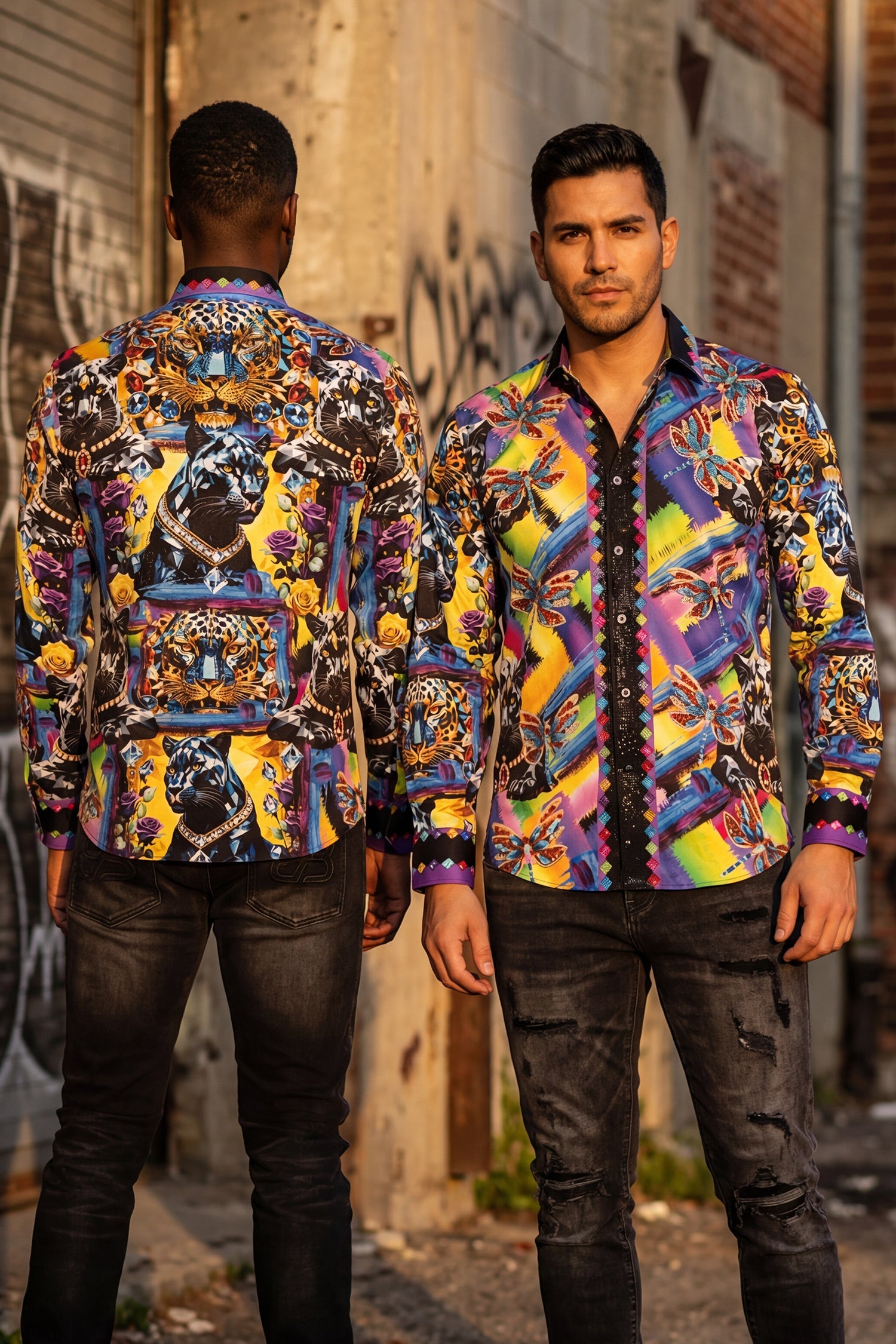
BARABAS has been at the forefront of this evolution. The brand's commitment to hand-placed rhinestones — individually set by skilled artisans rather than applied by machine — places it firmly in the tradition of genuine craft and luxury. Every piece in the collection, from the bold baroque artistry of the Baroque Era Rhinestone Long Sleeve Shirt to the refined geometric sophistication of the MEANDRO BORDERS Long Sleeve Shirt, carries this tradition forward into contemporary form.
Rhinestone Craft: What Hand-Placed Really Means
Modern manufacturing allows rhinestones to be applied to fabric through heat-transfer processes that can be executed at scale and speed. The results are fine for mass-market products, but they don't compare to hand-placed rhinestones in terms of durability, precision, or the quality of the visual effect they produce.
In a hand-placed rhinestone shirt like the Lively Fancy Rhinestone Long Sleeve Shirt or the Flitstitch Rhinestone Long Sleeve Shirt, each rhinestone is individually set by a craftsperson who ensures it sits at the correct angle, in the correct position, and with the correct pressure to maximize its light-refracting properties. The result is a uniform, brilliant effect that machine application simply cannot replicate.
This is why BARABAS rhinestone shirts photograph so beautifully, why they catch the light so dramatically in motion, and why they hold up so well through wear and washing. The craft behind them is genuine, and it shows in every detail.
From Stage to Street: What Rhinestone Fashion Means Today
The journey of rhinestone fashion from 18th-century theatrical costuming to 21st-century designer menswear is, at its core, a story about the democratization of spectacle. Men who once had to be performers to wear rhinestones can now simply be themselves — confidently, expressively, beautifully themselves — in a rhinestone shirt that was crafted specifically for that purpose.
Pieces like the True Angels Rhinestone Long Sleeve Shirt, the Andre Baroque Rhinestone Long Sleeve Shirt, and the Velcia Rhinestone Long Sleeve Shirt are the latest chapters in this history — pieces that honor the craft tradition behind rhinestone embellishment while moving it decisively forward into the present moment.
Wearing a BARABAS rhinestone shirt is, in a very real sense, participating in a centuries-long conversation about what it means for a man to show up fully, brilliantly, and without apology.
Explore the BARABAS rhinestone long sleeve shirt collection and find your place in that conversation.